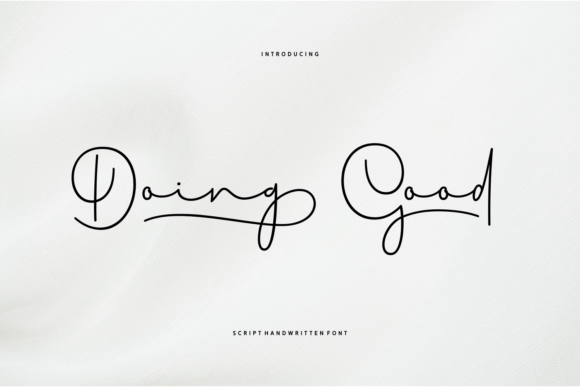
Doing Good Font: A Handwritten Script for Crafters & Sellers
If you've ever spent hours tweaking a label, re-cutting a sticker because the script looked too fussy, or hesitated before listing a printable because the font didn’t feel *quite* elegant enough—meet Doing Good. This isn’t just another handwritten script font. It’s a clean, modern typeface from Script Amp designed with makers like us in mind: thoughtful, practical, and deeply invested in how our products look, feel, and sell.
What sets Doing Good apart is its quiet confidence. Its smooth, flowing lines carry warmth without sacrificing clarity. The subtle flourishes—just enough at the start and end of letters—add personality but never overwhelm. There’s no excessive bounce, no exaggerated loops that snag on vinyl cutters or blur when scaled down. That balance makes it uniquely suited for real-world craft production—not just mood boards.
I use Doing Good across nearly every physical product I make: soy candle labels (especially for minimalist apothecary-style branding), boutique gift tags, wedding welcome signs cut on my Cricut Maker, and digital printables like planner headers and printable wall art. Its readability holds up beautifully at 8pt on a 1.5" kraft paper tag—and shines at 120pt on a farmhouse-style wooden sign. Because it’s built for both subtlety and presence, it works where many scripts fail: on matte black stickers, cream linen cards, and even light-colored ceramic mugs.
For Etsy sellers and small-batch creators, first impressions are everything. A well-chosen font like Doing Good quietly signals care and quality. Customers don’t read “handmade” and “premium”—they *feel* it. When your product packaging uses a refined script that pairs effortlessly with clean sans serif body text, your brand identity feels intentional, not improvised. That consistency builds recognition across listings, social posts, and physical goods—whether it’s a holiday ornament tag or a summer bridal shower invitation suite.
Here’s where Doing Good truly earns its place in my font library:
- Candle & soap labels: Its gentle curves complement natural ingredients and earthy tones—no harsh contrast, just calm sophistication.
- Wedding stationery: Use it for names and headings on save-the-dates, menus, and acrylic table numbers. It reads as timeless, not trendy.
- Digital printables: Planner covers, gratitude journals, and affirmation cards gain emotional resonance without sacrificing legibility.
- Svg designs for cutting machines: Clean vector paths mean crisp cuts on Silhouette Studio and Cricut Design Space—even at small sizes (down to 0.25").
- Seasonal product packaging: Think “Hand-poured • Small Batch • Made with Care” on holiday tea tins or spring lavender sachets.
Readability matters most where precision counts. On tiny stickers (think 0.75" round labels for honey jars), I stick to short phrases—names, single words like “Yes”, “Joy”, or “Wellness”. For longer text like ingredient lists or care instructions, I pair Doing Good with a neutral sans serif (like Montserrat or Inter) in a 14–16pt weight. That combination keeps hierarchy clear and avoids visual fatigue. And yes—it renders cleanly in mockup previews and PDF proofs, so what you design is what your customer receives.
Font pairing is where Doing Good really shines. As a display font, it’s meant to lead—not carry the whole load. Try it over a soft, open sans serif for labels and social graphics. Or layer it above a warm serif like Playfair Display for wedding invites where you want elegance with grounded structure. Avoid pairing it with other high-contrast scripts or overly decorative fonts—they compete instead of complement.
The Doing Good font family includes standard OpenType features: stylistic alternates, discretionary ligatures, and swashes—all accessible in design apps like Affinity Designer, Canva Pro, and Adobe Illustrator. These aren’t gimmicks—they’re tools. A single swash on the capital “D” adds polish to a boutique logo; an alternate “g” gives your greeting card a custom touch without extra work. It supports multilingual Latin-based languages (including accents for French, Spanish, and German), which matters if you sell internationally or create bilingual baby announcements.
All files come in OTF and TTF formats—fully compatible with cutting machine software, Canva, Google Docs (via upload), and desktop design suites. No font manager required, no hidden limitations.
And yes—Doing Good comes with a commercial license. That means you can use it confidently in templates you sell on Etsy, SVG files for Cricut users, printable planners, client branding projects, and physical products like shirts, tote bags, and enamel pins. You’re covered whether you’re printing 10 or 10,000 units. Just remember: the license covers *your use* in derivative products—not redistribution of the font file itself.
As a maker who’s tested dozens of script fonts, I keep coming back to Doing Good because it doesn’t ask me to choose between beauty and function. It doesn’t sacrifice legibility for flair, or simplicity for soul. It’s the kind of font that makes your candle smell better, your invitation feel more personal, and your brand look like it was thought through—every single time.
When your hands shape the product, your font should reflect that same intention. With Doing Good, it does.